- This topic is empty.
-
AuthorPosts
-
-
October 22, 2025 at 3:17 am #10884
Kris Marker
KeymasterWe post news and comment on federal criminal justice issues, focused primarily on trial and post-conviction matters, legislative initiatives, and sentencing issues.

CLOSED FOR REMODELING
 Usually, when you see a hand-scrawled sign on a restaurant door that the place is “closed for remodeling,” the between-the-lines message is that the place is out of business until the next unlucky owner can be fleeced.
President Trump’s government closed on October 1st because the Democrats refuse to sign on to a continuing resolution keeping the Feds funded unless healthcare cuts are restored. When that happened, the federal courts announced that they had enough money in the coffers to keep operating at least until October 17th.
Last Friday, the “Closed for Remodeling” signs went up.
Unlike executive branch federal agencies, the federal courts been able to sustain paid operations for a few weeks after the shutdown by using fees and other funds courts have collected that are not dependent on Congress. But tight budgets in recent years meant the courts entered this shutdown with less money in the bank than they had during the 35-day 2019 shutdown, during which the courts sustained paid operations for whole length of the impasse.
A few weeks ago, Administrative Office of United States Courts estimated that court funding would be exhausted by last Friday. And, as forecast, it was.
 The AOUSC – the central support agency for courts providing a wide range of legislative programs, budgeting and administrative support services – announced late last Friday that beginning on Monday, Oct 20, it will no longer have funding to sustain full operations, and until the shutdown ends, federal courts will maintain limited operations necessary to “perform the Judiciary’s constitutional functions.”
 This followed an internal memorandum circulated the day before explaining that “If Congress does not pass and the President sign into law legislation funding the Judiciary’s operations, we will enter Phase 2 of this lapse in appropriations beginning Monday, October 20, 2025… During the morning of October 20, furlough notices will be distributed, and orderly shutdown activities will commence.”
Federal judges will continue to be federal judges – nothing can change that – but clerks’ offices and court staff “may only perform certain excepted activities permitted under the Anti-Deficiency Act.” The ADA prohibits the government from entering into any contract – including paying employees to work – that is not “fully funded,” because doing so would obligate the government in the absence of an appropriation adequate to the needs of the contract.
The AOUSC said that “excepted activities” include work necessary to perform Article III constitutional functions, activities necessary for the safety of human life and protection of property, and activities otherwise authorized by federal law. Employees will be expected to perform such duties “without pay during the funding lapse. Staff members not performing excepted work will be placed on furlough.”
Each appellate and district court is expected to make its own decisions on how to manage its cases and probation/pretrial supervision services during the shutdown. Each court and federal defender’s office will determine how it will find the resources needed to support the work the court deems essential.
AOUSC’s message to courts seems to be ‘you’re on your own.’
PACER, which is more than amply funded by user fees, will continue to be operated.
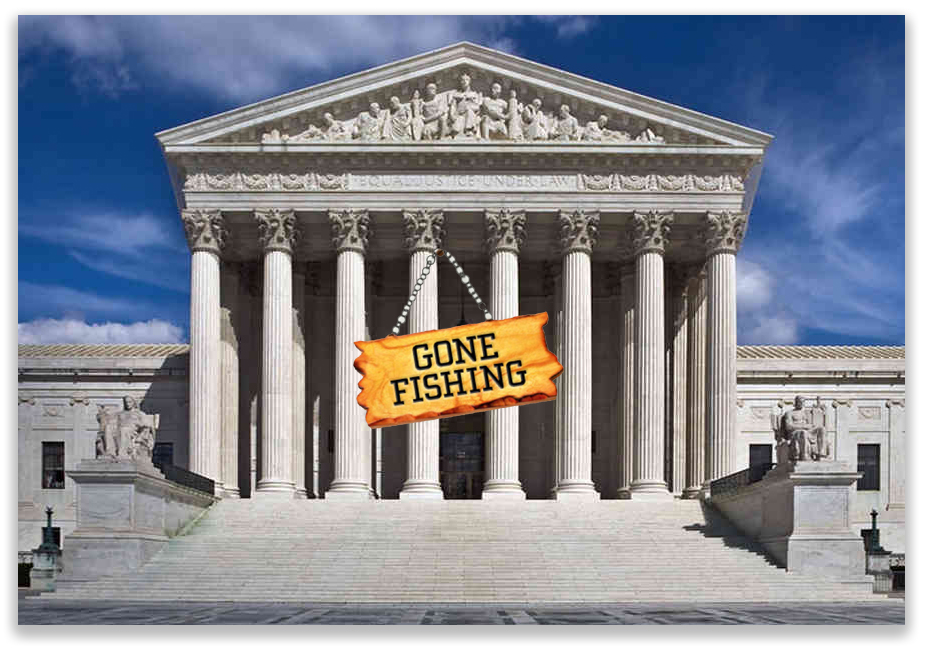 The Supreme Court announced that it, too, will be furloughing staff and be closing the building to public tours. SCOTUS “expects to run out of funding on October 18,” Patricia McCabe, Supreme Court public information officer, told The Hill last week. “As a result, the Supreme Court Building will be closed to the public until further notice… The Supreme Court will continue to conduct essential work such as hearing oral arguments, issuing orders and opinions, processing case filings, and providing building support needed for those operations.”
Sounds like business as usual at SCOTUS.
As for what individual courts will do during the shutdown, expect those announcements during this coming week.
AOUSC, Judiciary Funding Runs Out; Only Limited Operations to Continue (October 17, 2025)
AOUSC, Guidance For Judiciary Operations During Phase 2 Of The Lapse In Appropriations (October 16, 2025)
Reuters, US courts set to run out of money, begin furloughs as shutdown lingers (October 17, 2025)
The Hill, Supreme Court to run out of funding due to shutdown (October 17, 2025)
~ Thomas L. Root
-
-
AuthorPosts
- You must be logged in to reply to this topic.