- This topic is empty.
-
AuthorPosts
-
-
March 5, 2026 at 3:13 am #11589
Kris Marker
KeymasterBecause it is not a state, Washington D.C.’s criminal legal system operates in a uniquely vulnerable situation. Although historically, D.C. has largely developed and enforced its own laws regarding pretrial practices and sentencing, the federal government retains the ultimate statutory authority to change D.C.’s laws unilaterally, without the input of the people who live there. Recently, about a dozen bills targeting D.C.’s justice system have moved through federal House committees, and several have passed the House. These bills seek to undo decades of successful reform in D.C. and return its justice system to failed 90s-style tough on crime policies that are widely disfavored by D.C. residents.
Federal officials target D.C.’s criminal legal system because for the most part, they don’t have the ability to set local criminal justice policy in states. As the Trump administration and conservatives in Congress seek to turn back the clock on decades of successful criminal legal system reform, D.C. provides a window into which parts of the system are likely to be targeted by conservative forces in the future, including in state legislatures where these kinds of policy changes could impact millions of people.
In this piece, we’ll examine three of the efforts to change D.C.’s criminal legal system: threats to bail reform, reinstatement of mandatory minimums, and efforts to treat more youth as adults. We also take a look at similar efforts in various state legislatures to roll back reforms. The collective impact of these proposed policy changes would be to expand jail and prison populations, along with racial disparities, without any public safety benefit.
Pretrial practices: returning to an ineffective cash bail system
The “District of Columbia Cash Bail Reform Act of 2025” (or HR 5214) would undo one of the most successful and unusual aspects of D.C.’s criminal legal system: the fact that it does not use cash bail. D.C. virtually eliminated the use of cash bail in an overhaul of its criminal system in 1992. Since then, it has replaced cash bail with a risk-based detention system, in which a pretrial services agency assesses a person’s risk level and makes a recommendation regarding release to a judge, who then decides if the person should be released pretrial. HR 5214 would require mandatory pretrial detention for certain crimes, and would require the use of cash bail for others — most notably for various “public safety or order crimes” often associated with protest arrests, like obstruction of justice, rioting, and destruction of property.
D.C.’s current risk-based pretrial system is atypical but successful. Similar systems are in place in the federal courts and New Jersey, which also rarely use cash bail, and Illinois has completely eliminated cash from its pretrial system. In fiscal year 2025, 89% of people charged with crimes were released without cash bail (the remainder were mostly held in D.C.’s jail without the ability to pay to be released). Of the people released, 88% were not re-arrested during their pretrial period and 88% attended all their court dates. Only 0.5% of people were re-arrested for a violent crime. These outcomes hold true even when people charged with violent crimes are released; in 2025, only 9 people initially released for a violent crime were then re-arrested for a new violent crime while on pretrial release.
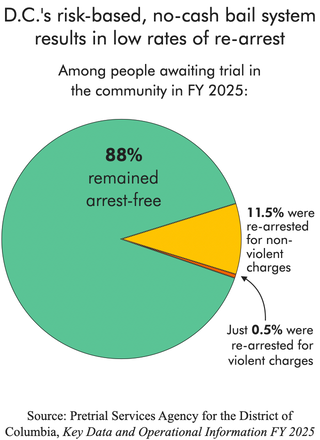
There is no evidence that using cash bail improves public safety or promotes appearance in court. States and municipalities that have eliminated or reduced their use of cash bail have seen their crime rates stay steady or fall, and have not seen a rise in failures to appear. Cash bail causes people to be jailed unnecessarily, which likely reduces public safety in the long run, since jailing someone for any length of time makes it more likely that they will be rearrested in the future.
The federal government has no power to force states and municipalities to use cash bail the way it can in D.C. However, state legislatures around the country have shown a willingness to entrench the failed system of cash bail into their criminal legal systems. Ohio and Wisconsin have both enshrined the use of cash bail in their state constitutions in recent years, despite the lack of evidence that cash bail does anything to ensure public safety. And around the country, states have attacked charitable bail funds, making it harder for poor people to pay cash bonds.
Advocates facing campaigns to reinstate cash bail can focus on some key points. First, bail reform isn’t driving crime in the states that have eliminated cash bail. Violent crime in Illinois fell 7% and property crime declined 14% after reforms. In New Jersey, violent crime dropped 20% after reforms and court appearance rates remained high. Nationwide studies have found no link between bail reform and rises in crime. Second, Money bail does immense harm to communities. There is no evidence that money bail reduces re-arrest or failure to appear rates. Meanwhile, it extracts money from poor communities while primarily benefitting a $2 billion private bail bonds industry.
Mandatory minimums: resurrecting failed “tough-on-crime” policies
The “Strong Sentences for Safer D.C. Streets Act of 2025” (or HR 5172) would impose a range of mandatory sentences that had previously been removed from D.C.’s criminal legal system. It would require mandatory life without parole sentences for first degree murder, and would remove a provision of D.C. law that prohibits the use of life without parole sentences for juveniles. It also establishes mandatory minimums of at least seven years for a range of serious charges. D.C. already has harsh sentencing structures, and 1 in 5 sentences imposed in D.C. is a mandatory minimum.
More than 30 years of evidence has shown that mandatory minimums do not improve public safety. They fail to reduce crime, gun possession, drug use, or overdoses. They also intensify racial disparities. Mandatory minimum sentences remove a judge’s discretion to consider the individual facts and circumstances of each crime when setting a sentence. By doing so, they place more power in the hands of prosecutors, who can make initial charging decisions that carry mandatory minimums, coercing accused people into pleading guilty. This power imbalance has been shown to result in longer sentences for Black people because they are more likely than white people to be charged with mandatory minimum crimes.
Although efforts around the country to reinstate or extend mandatory minimums are being challenged by organizations like Families Against Mandatory Minimums, some states have recently passed sentencing reforms that have the same effect, requiring that people spend longer in prison. Arkansas, Louisiana, and Tennessee have all enacted punitive “truth in sentencing” laws that are projected to massively grow their prison populations and likely require billions in new spending. Louisiana did so in conjunction with ending parole for most people, vastly extending the amount of time people are likely to spend in prison in the state.
Advocates facing efforts to lengthen sentences are sometimes in a difficult position because the crimes being targeted for longer sentences are often particularly heinous. But they can remind lawmakers that mandatory minimums don’t work, and that they also create a massive waste of government resources imprisoning people who judges did not want to sentence to such long sentences. “Fiscal notes” — analyses of potential criminal legal reform bills’ monetary impact, usually conducted by legislative analysts within the government — regularly conclude that efforts to expand mandatory minimums cost millions. In addition, victims of crime by and large do not support long sentences: a nationwide survey of crime survivors conducted by the Alliance for Safety and Justice found that only 16% agreed with the statement, “When there are longer prison sentences, crime goes down.”
Ignoring science and common sense: treating youth as adults
Crime committed by children and youth is at historic lows in D.C. and elsewhere in the country. Nonetheless, the U.S. House and Senate have advanced a set of three bills that would harshen penalties for youth in D.C., treating more of them as adults:
- HR 5140 would “lower the age” that a minor may be tried as an adult, from 15 or 16 for serious cases to 14 years of age.
- S 2815 would repeal D.C.’s youth-focused “Second Look” provision, which allows reconsideration of sentences for people who committed crimes before age 25 after they have been in prison for 15 years.
- HR 4922 would remove requirements to consider alternatives to incarceration, consider youth brain development in sentencing, and seal records for people between 18 and 24 years old.
Jeanine Pirro, a close Trump ally and the current U.S. Attorney for D.C., defended these laws, claiming, “I know evil when I see it, no matter the age.” This language harkens back to damaging “super predator” rhetoric from the 1990s, which falsely painted the picture of youth — particularly Black youth — who were irredeemably evil or callous toward human life.
These depictions of youth who commit crime are no more true now than they were three decades ago. On the contrary, both common sense and neuroscience show that brain immaturity is the primary driver of delinquent behavior; as people age and their brains mature, their likelihood of committing crime declines. Most youth (63%) who enter the justice system for delinquency never return to court on delinquency charges. Even among youth charged with serious crimes, research shows that only 9% continued to commit serious offenses over the next three years. Incarceration creates a roadblock to outgrowing delinquency, holding youth back from maturing psychologically and making it more likely that children will be rearrested in the future.
The efforts to roll back D.C.’s youth-focused reforms are not unique. Despite youth crime being at all-time lows, Louisiana Governor Jeff Landry called a special legislative session to deal with “out of control” youth crime. It resulted in the repeal of Louisiana’s 2019 “raise the age” law, essentially reverting to the state’s previous practice of treating all 17 year olds as adults, regardless of how minor their charges were. North Carolina also repealed its “raise the age” law and now treats all 16 year olds as adults, despite state-sponsored reports that found that raising the age had not raised recidivism rates.
What is happening in D.C. is relevant to the whole country. Even as state criminal legal systems stay relatively insulated from the policy directives of the Trump administration, the situation in D.C. can give state-level advocates some sobering clues about the full scope of the conservative agenda to roll back decades of successful criminal legal system reforms. We hope that advocates will put pressure on their own congresspeople and senators to resist these harmful changes.
-
-
AuthorPosts

- You must be logged in to reply to this topic.