- This topic is empty.
-
AuthorPosts
-
-
February 25, 2026 at 3:14 am #11536
Farrydesigner
KeymasterMaking sure people have food to eat is one of the most important ways to support them when they’re on probation. But there is a legislative patchwork across the U.S. that prevents and deters people on probation from receiving vital federal food assistance, known as SNAP benefits.1 This patchwork means that some people on probation in some states can’t afford to purchase basic foods, with serious consequences for their health, their family’s health, and their ability to comply with their conditions of probation. We analyzed state SNAP laws and applications in all 50 states and found that 39 states have some kind of probation violation-related disqualifications for SNAP benefits. This includes states that explicitly ban people with probation violations from participating in the program, as well as states that discourage eligible people from applying by adding irrelevant questions about probation to their SNAP application.
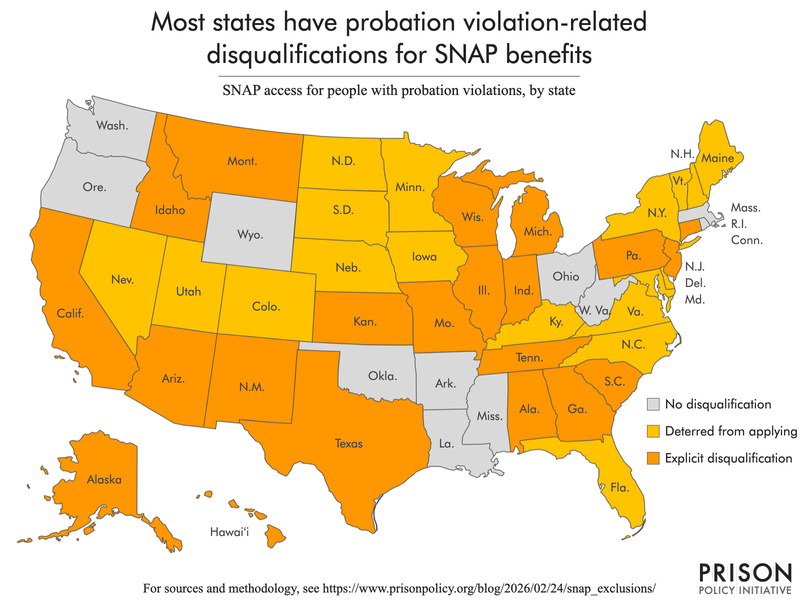
These variations in SNAP eligibility arose because the federal law that created the program disqualifies people with certain drug convictions from receiving benefits. Under the law, states can opt out of these federal eligibility rules and allow people who have convictions to access SNAP.2 However, many states have chosen a misguided middle path, maintaining a carve-out that denies benefits to some people on probation.The most common of these disqualifications is for people with “probation violations.”3 These disqualifications have two negative effects: first, they directly disqualify people who have a probation violation, and second, they indirectly discourage many more eligible people from even applying.
In this briefing, we highlight restrictions on SNAP benefits for people with probation violations, their impact, and how advocates are pushing back. First, we explain the scope of the impact — the country’s rampant use of probation, its overlap with high levels of poverty and food insecurity, and how states differ in expanding or limiting SNAP access with policies related to probation violations. Then, we show how increasing SNAP access to people on probation will improve public safety. Finally, we dive into the legal framework and present several possible solutions, highlighting how advocates are working to expand access to SNAP in Connecticut. We also include a state-by-state appendix of probation violation-related SNAP disqualifications.
Millions of people on probation are affected by SNAP restrictions
Food insecurity is rampant in the U.S.; 41.7 million people — nearly 1 in 8 Americans — receive SNAP benefits. Meanwhile, the number of people on probation in the United States (2.9 million) is even bigger than the total number of people behind bars.
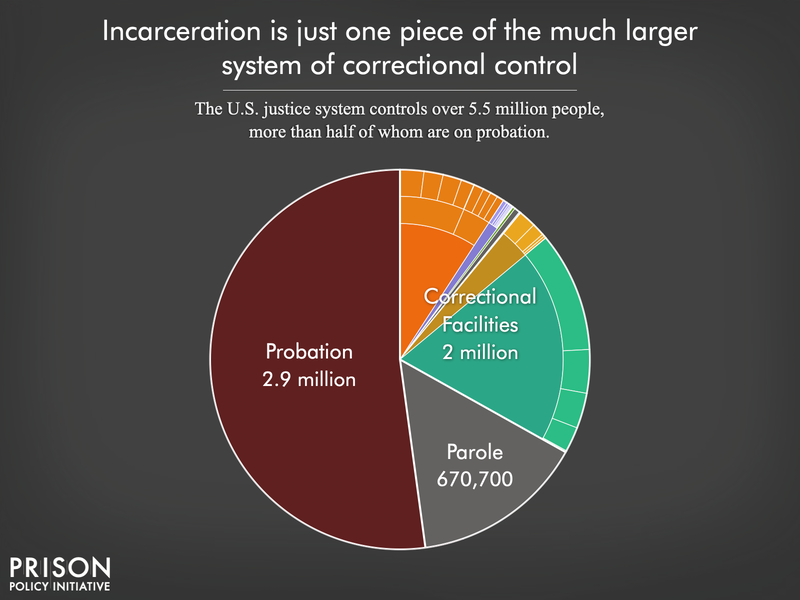
Many people on probation depend on SNAP to feed themselves and their families, and they face questions on their SNAP applications about whether they are on probation and whether they have any violations. In many states, people with probation violations are disqualified from SNAP. However, because these applications often threaten harsh consequences for misrepresentations or mistakes,4 simply asking about probation violations has a chilling effect on all people on probation, likely keeping people from applying even when they are eligible.
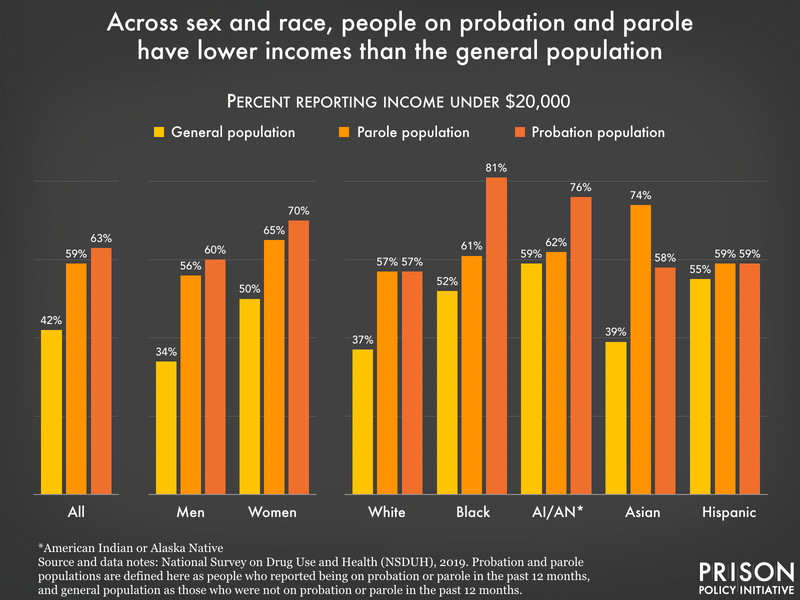
This chilling effect has a broad impact on the probation population because so many people who are on probation are also poor. Over half of people on probation earn under $20,000 per year, which is below the SNAP income eligibility cap of $22,352. A breakdown by race and gender reveals stark differences in people’s access to even that meager income: For example, 70% of all women, and 81% of Black women on probation in particular, make less than $20,000 a year. In other words, limiting access to SNAP has a disproportionate impact on women on probation.5
States are split on whether a probation violation actually disqualifies someone from receiving SNAP benefits. For our analysis, we grouped states into two general categories: those that have probation-related roadblocks for SNAP eligibility, and those that don’t. We found that:
- 11 states don’t have any probation-related disqualifications.
- 39 states have or threaten probation-related disqualifications. Of those 39 states:
- 21 states have a statutory disqualification for people on probation, either through a partial opt-out from the federal drug offense disqualifications or by separately adding disqualifications for probation violations.
- 18 states don’t have any statutory probation violation disqualifications, but ask about probation violations on their SNAP application anyway — even though the answer is irrelevant to eligibility.
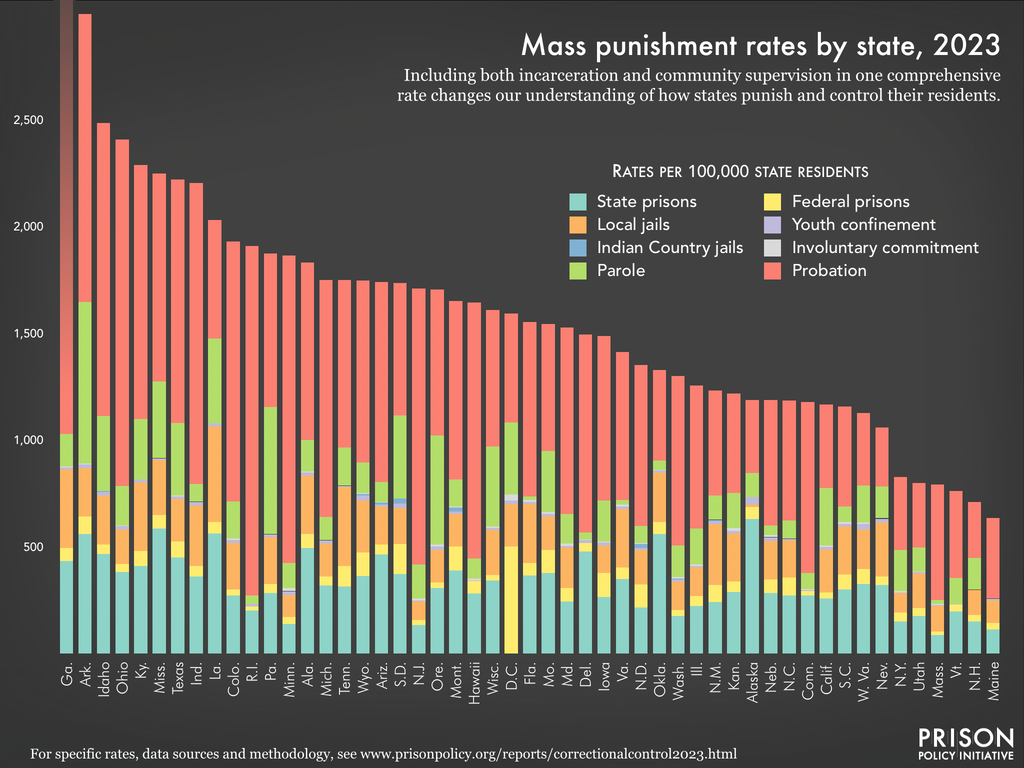
Some of the states with the highest rates of people on probation — including Georgia, Hawaii, Idaho, Indiana, Minnesota, and New Jersey — either bar people with probation violations from accessing SNAP entirely or at least ask about probation violations on their applications.
The confusing federal definition of ‘probation violator’ creates additional problems
A “probation violation” may seem straightforward but the states and federal regulations ascribe very different meanings to the term.
A “probation violation” may seem straightforward but the states and federal regulations ascribe very different meanings to the term.
Separate from provisions that disqualify people with drug-related offenses from SNAP eligibility, federal regulations do mention “probation or parole violators” as a category of people who are disqualified from SNAP (7 CFR S 273.11(n)(2)-(3)). This could be why state agencies that administer SNAP believe it is necessary to ask about probation violations. However, reading the full language of the regulations, it’s clear that the terms “probation and parole violators” are defined very narrowly.
Federal SNAP regulations define a “probation violator” as someone who has a warrant for their arrest as a result of the violation or because they are actively fleeing law enforcement. Obviously, most people would read the phrase “probation violator” as broader than just people “actively fleeing” law enforcement or having a warrant. This means there is ample room for states to reform their laws to allow the vast majority of people on probation to access SNAP. To be clear, the only people who are currently required to be excluded under the federal regulations are people actively on the run from law enforcement.
We found 18 states that ask about probation violations on their SNAP applications, even though the answer is irrelevant to their eligibility criteria based on the state’s statutory language.6 Virginia, for example, got rid of their probation violation disqualifications in 2020, but still asks about the violations on its SNAP application, even after revising the form for other purposes in 2022. The Virginia situation exemplifies that reform cannot stop at legislative change, but must actively involve the implementing agencies to create updated forms in a timely manner.
If a state-level department in charge of administering SNAP indicates that they will be keeping mentions of probation violation because of the federal disqualification of “probation violators,” then we recommend that the question use the specific federal definition of the term, rather than just vaguely referring to “probation violations” as a whole. Arkansas serves as a good model for this type of transparent approach; their form asks whether the applicant is “fleeing from felony prosecution, outstanding felony warrant, or jail.”
Combatting food insecurity is key to public safety
Ostensibly, the purpose of probation is to help people become successful members of society, and food security is a key component of this goal. Food security lowers crime rates and reduces recidivism, leading to improved public safety, all while spending fewer taxpayer dollars on incarceration.
Food insecurity is likely rampant among people on probation. Although there are no studies that specifically look at the number of people on probation who experience food insecurity, studies have been conducted regarding formerly incarcerated people. Twenty percent of formerly incarcerated people report suffering from food insecurity — double that of the general population — with even higher rates among women and Black people. While we don’t have food insecurity data specifically on children of people on probation, we know that they are more likely to experience food insecurity than children of non-incarcerated parents. Over a quarter of people on probation are parents living with their children, so ensuring SNAP access for their households means fewer children going hungry.
Furthermore, meeting people’s basic needs reduces crime. One study found food security was linked to increased neighborhood safety and social cohesion, and lower violent crime rates. Studies have also linked lower rates of recidivism directly to SNAP access, explaining that “[b]locking the formerly incarcerated from basic nutrition assistance […] leaves them more vulnerable to food insecurity and may put them at risk of returning to illicit activity to meet their basic needs. Some research suggests that full eligibility for SNAP may significantly reduce the risk of recidivism for newly released people with drug offense convictions.”
When governments ensure that people have food, it not only reduces crime but makes it easier for people to meet their probation requirements in the first place, and thus avoid incarceration for probation violations. Indirectly, having access to adequate food makes it easier to succeed at work or school, which are standard conditions of probation. More directly, having supplemental income for food helps people to meet the financial obligations of probation, such as fines, fees, restitution, and monthly supervision fees.7
Reforming SNAP eligibility in Connecticut and beyond
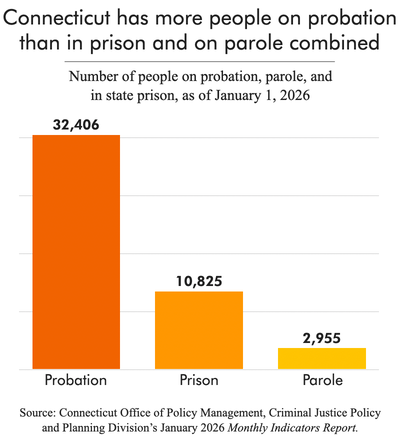
Ensuring food security through SNAP is so impactful that advocates in Connecticut are fighting for change. The state has over 32,000 people on probation, but limits their eligibility and access to SNAP benefits.
Connecticut has chosen to opt-out of the federal SNAP disqualifications for people convicted of drug offenses, but the state preserves a few carve-outs nonetheless. One such caveat is that Connecticut requires that people on probation be “satisfactorily serving” their sentence in order to be eligible for SNAP benefits.
In applying this law, Connecticut’s application for SNAP benefits asks:
“Do you or any member of your household have a probation or parole violation?”
The form leaves no room for nuance; the only answer options are checkboxes for “Yes” or “No.” Yet neither the Instructions (W-1EINST) nor the Rights & Responsibilities pages (W-0016RR) in the SNAP application packet provide any guidance on what constitutes a “probation violation” for the purposes of the form. The vagueness of the form, and the severe penalties for getting the answer wrong lead many people who are eligible for SNAP not to risk applying.
Chicks Ahoy Farm, a Connecticut nonprofit that focuses on increasing the number of women and BILPOC farmers in Connecticut, is working to fix this. The organization works to strengthen youth and families’ access to farming, agriculture, conservation, and environmental stewardship, while fixing the state’s broken social safety net. Their member-led community organizing group, Cultivating Justice, is leading the F.R.E.E. CT campaign, which works at the intersection of food justice and criminal justice to dismantle barriers in Connecticut’s social safety net that impede successful community reentry for justice system-impacted individuals. Their current campaign is focused on reforming probation to limit the impact of technical violations and ensure SNAP access. The easiest way to restore SNAP access for people on probation is to change the current statutory language governing SNAP eligibility. In Connecticut, the current statute requires that people on probation are “satisfactorily serving” their sentence in order to be eligible for SNAP benefits. Fixing this problem requires deleting a single word:
“A person convicted of any offense under federal or state law, on or after August 22, 1996, which (1) is classified as a felony, and (2) has as an element the possession, use or distribution of a controlled substance, as defined in Subsection (6) of 21 USC 802, shall be eligible for benefits pursuant to the temporary assistance for needy families program or the supplemental nutrition assistance program pursuant to the Food and Nutrition Act of 2008, if such person has completed a sentence imposed by a court. A person shall also be eligible for said benefits if such person is
satisfactorilyserving a sentence of a period of probation or is in the process of completing or has completed a sentence imposed by the court of mandatory participation in a substance abuse treatment program or mandatory participation in a substance abuse testing program.”A more expansive option available to states is simply opting out entirely of federal disqualifications linked to drug offenses. States can exercise the federally-permitted opt-out provision, as Delaware does:
Pursuant to the option granted the State by 21 U.S.C. § 862a(d)(1), an individual convicted under federal or state law of a felony involving possession, distribution or use of a controlled substance shall be exempt from the prohibition contained in 21 U.S.C. § 862a(a) against eligibility for food stamp program benefits for such convictions.
In addition to these legislative changes, we recommend that advocates be vigilant in working with the state agency responsible for administering SNAP in the state. Even if the law changes to remove probation disqualifications or totally opt the state out of the drug conviction disqualifications, the state may still continue to ask the question on their forms, either because they are unaware of the law change or because they believe that federal regulations require them to do so. But because the question itself is a deterrent to applying for SNAP, it’s important that the application form is updated quickly and accurately to reflect the law.
States need to follow sound policy and create clear, straightforward laws that ensure that people on probation have access to SNAP. Expanding SNAP access to people regardless of probation-related violations will improve public safety and improve the lives of people on probation and their families. Solving the problem is an easy legislative fix — and in some cases, simply an administrative one. States across the country should follow the lead of the 11 states that ensure access to SNAP regardless of conviction or probation violation status.
Footnotes
-
The Supplemental Nutrition Assistance Program, or SNAP, is a state-administered federal program that provides food assistance to people with low incomes, and used to be known as “food stamps.” ↩
-
The federal law which sets out the rules for SNAP disqualifies people who have certain drug convictions (21 USC §862a(a)). However, it also allows states to opt out of those provisions (21 USC §862a(d)(1)(A)). ↩
-
“Probation violations” may seem like a straightforward term but is in fact ill-defined, with often conflicting definitions between state and federal law. For more information, see our sidebar:. ↩
-
Connecticut’s SNAP application, Form W1-E requires signature attesting that: “The information I am giving is true and complete to the best of my knowledge, including all information about citizenship, alien and felon status” and “I could go to prison or be required to pay fines if I knowingly give wrong or incomplete information…” ↩
-
Women are also already disproportionately likely to end up on probation. While 53% of all people under correctional control are on probation, but that figure jumps to 75% for women, meaning that disqualifications that apply to people on probation apply disproportionately to women. ↩
-
Further adding to the problem, some states have combined applications that ask about probation or parole violations because it’s a disqualifying factor for one of the other assistance programs that use the same form. Some states flag which questions pertain to which program, but others don’t, creating a chilling effect on SNAP applications. Solving this problem would be as easy as allowing applicants to skip questions that are irrelevant to the particular program they’re applying for. For example, Minnesota’s combined application actually flags some questions as “SNAP only,” but then asks about probation violations generally even though they are grounds to disqualify from other assistance programs, but not SNAP. Minnesota could easily add such a flag to limit the probation violation question to the relevant program. ↩
-
In Connecticut, this includes a $200 “adult probation supervision fee.“ ↩
Appendix Table: SNAP eligibility for people with probation violations, by state
State Probation violation-related disqualifications Statutory basis for opt-out or disqualifications Does the SNAP application ask about probation violations? Alabama Explicit disqualification AL Code § 38-1-8 Y Alaska Explicit disqualification AK Stat § 47.27.015 Y Arizona Explicit disqualification Airiz. Rev. Stat. Ann. § 46-219 Y Arkansas Total opt-out, no disqualification AR Code § 20-76-409 N California Explicit disqualification CA Welf & Inst Code § 18901.3 [Uncertain, requires online log‑in] Colorado Application question despite having no explicit disqualification CO Rev Stat § 26-2-706 Y Connecticut Explicit disqualification CT Gen Stat § 17b-112d Y Delaware Application question despite having no explicit disqualification 31 DE Code § 605 Y Florida Application question despite having no explicit disqualification Fla. Stat. Ann. § 414.095 (14)(g) Y Georgia Explicit disqualification O.C.G.A. § 49-4-22 Y Hawaii Explicit disqualification Haw. Rev. Stat. § 346-29 Y Idaho Explicit disqualification Idaho Code Ann. § 56-202 Y Illinois Explicit disqualification 305 Ill. Comp. Stat. Ann. 5/1-8 Y Indiana Explicit disqualification Ind. Code Ann. § 12-14-30-3 Y Iowa Application question despite having no explicit disqualification Iowa Code Ann. § 234.12 Y Kansas Explicit disqualification Kan. Stat. Ann. § 39-709e Y Kentucky Application question despite having no explicit disqualification Ky. Rev. Stat. Ann. § 205.2005 Y Louisiana Total opt-out, no disqualification La. Rev. Stat. Ann. 46:233.3 Y Maine Application question despite having no explicit disqualification Me. Rev. Stat. tit. 22, § 3104(14) Y Maryland Application question despite having no explicit disqualification MD HUMAN SERV § 5-601 Y Massachusetts Total opt-out, no disqualification Regs: 106 CMR 360.00 N Michigan Explicit disqualification Annually included in appropriations bill (HB 4706 in 2025) Y Minnesota Application question despite having no explicit disqualification Minn. Stat. Ann. § 142G.18 Y Mississippi Total opt-out, no disqualification Miss. Code Ann. §43-12-71 [Uncertain, requires online log‑in] Missouri Explicit disqualification Mo. Ann. Stat. § 208.247 Y Montana Explicit disqualification Regs: MT DPHHS SNAP 304-1 [Uncertain, requires online log‑in] Nebraska Application question despite having no explicit disqualification Neb. Rev. Stat. § 68-1017.02 Y Nevada Application question despite having no explicit disqualification Nev. Rev. Stat. Ann. § 422A.345 Y New Hampshire Application question despite having no explicit disqualification N.H. Rev. Stat. Ann. § 167:81-a Y New Jersey Explicit disqualification N.J. Stat. Ann. § 44:10-48(b)(6) Y New Mexico Explicit disqualification N.M. Stat. Ann. § 27-2B-11 Y New York Application question despite having no explicit disqualification According to the USDA State Options report (no statutory cite exists) Y North Carolina Application question despite having no explicit disqualification N.C. Gen. Stat. Ann. § 108A-25.2 Y North Dakota Application question despite having no explicit disqualification ND Century Code 50-06-05.1 Y Ohio Total opt-out, no disqualification Ohio Rev. Code Ann. § 5101.84 N Oklahoma Total opt-out, no disqualification 1997 Okla. Sess. Law Serv. Ch. 414 (H.B. 2170) §§28, 31 N Oregon Total opt-out, no disqualification Or. Rev. Stat. Ann. § 411.119 N Pennsylvania Explicit disqualification 62 P.S. § 432.24 (P.S. – Purdon’s Statutes) Y Rhode Island Total opt-out, no disqualification R.I. Gen. Laws Ann. § 40-6-8 Y South Carolina Explicit disqualification [None – kept full federal ban] Y South Dakota Application question despite having no explicit disqualification S.D. Codified Laws § 28-12-3 Y Tennessee Explicit disqualification Tenn. Code Ann. § 71-5-308 Y Texas Explicit disqualification Tex. Hum. Res. Code Ann. § 33.018 N Utah Application question despite having no explicit disqualification Utah Code Ann. § 35A-3-311 Y Vermont Application question despite having no explicit disqualification Vt. Stat. Ann. tit. 33, § 1203a Y Virginia Application question despite having no explicit disqualification Va. Code Ann. § 63.2-505.2 Y Washington Total opt-out, no disqualification Wash. Rev. Code Ann. § 74.08.025 N West Virginia Total opt-out, no disqualification W. Va. Code § 9-2-3a N Wisconsin Explicit disqualification Wis. Stat. Ann. § 49.79 (6) Y Wyoming Total opt-out, no disqualification WY Stat. §42-2-103(B)(xiii) N
-
-
AuthorPosts


- You must be logged in to reply to this topic.