- This topic is empty.
-
AuthorPosts
-
-
March 25, 2026 at 3:14 am #11733
Farrydesigner
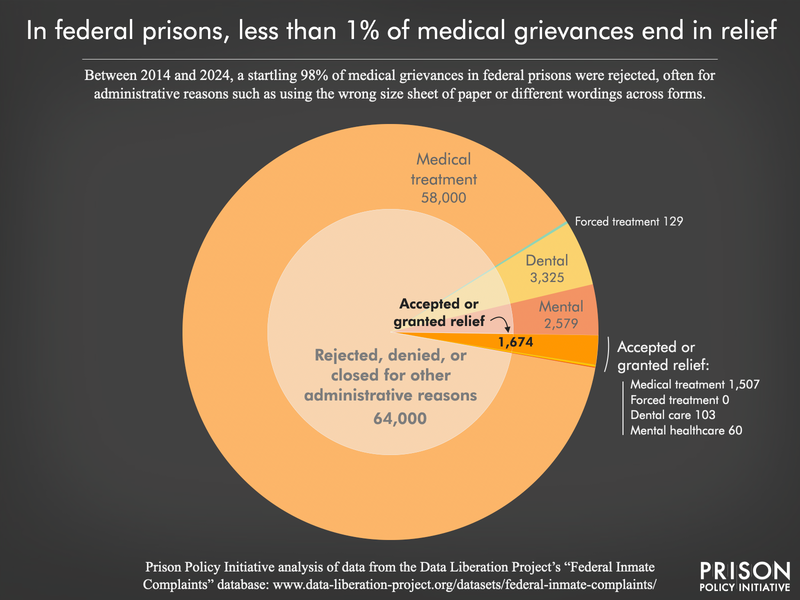
KeymasterWhen incarcerated people face abuse and mistreatment, they can typically file a formal complaint with jail or prison administrators. In federal prisons, the system for resolving these complaints is known as the “Administrative Remedy Program,” but it’s more commonly referred to as a “grievance system” in state prisons and local jails. Grievance systems are supposed to provide incarcerated people with a way to challenge issues they face behind bars — such as inadequate medical care, harassment by corrections officers, or unsanitary living conditions — and (hopefully) receive some kind of relief. In practice, however, incarcerated people who turn to grievance systems are forced to run a gauntlet of rules and regulations just to be heard, and very rarely succeed. This is especially true when it comes to medical complaints: our analysis of a decade of data from the Data Liberation Project finds that, between 2014 and 2024, a startling 98% of medical grievances were rejected for reasons ranging from the bureaucratic (such as using the wrong size sheet of paper) to the substantive (actually being denied on the merits of the complaint). Less than 1% of medical cases ended in a grant of relief.
A functioning grievance system is an important lifeline for incarcerated people, who have very little leverage to affect their circumstances. It’s especially important for health-related matters, given that incarcerated people suffer from illness and disease at rates far exceeding that of the general public, and their access to medical care is highly constrained and notoriously awful. But in the end, a system does what it is designed to do, not what it is intended to do, and the federal grievance system rejects nearly every medical complaint filed by incarcerated people, often for vague or trivial reasons.
In this briefing, we examine the statuses of nearly 66,000 medical grievances from across the Bureau of Prisons to determine what kinds of medical complaints are most common in the federal system and how incarcerated people fare in their pursuit of relief.
The federal prison grievance system is designed to shut down complaints
Major segments of the U.S. population struggle to obtain basic medical care, but incarcerated people face especially challenging barriers and limitations such as the inability to choose doctors, get second opinions, or continue treatments prescribed prior to their incarceration. Conditions are so bad on the inside that since 2000, roughly half of all state prison systems have been court-ordered to improve mental and medical healthcare.
The sheer volume of correctional healthcare lawsuits reflects how ineffective prison grievance systems are for incarcerated people. After all, grievance systems should help people address their concerns so that neither side has to engage in costly, time-consuming litigation. Instead, grievance systems gatekeep actual opportunities for accountability in the courts.
The federal Bureau of Prisons’ grievance system, in the simplest terms, works like this:
- Informal resolution: An incarcerated person must first attempt to resolve their complaint informally by speaking directly to the person with whom they have an issue. As one might imagine, this first hurdle can easily dissuade people from pursuing their complaint for fear of retaliation — especially when that person works for the prison.
- Formal resolution: If they can’t informally resolve the issue, an incarcerated person can file a formal complaint with the warden, who is supposed to investigate and respond. To do this, the incarcerated person must overcome tedious administrative hurdles for their complaint to even be considered, including adhering to short deadlines1 and specific requirements like using the correct paper size, attaching the right number of copies, or using the right form (of which there are many).
- Appeals: If the warden denies the grievance or fails to resolve it, the incarcerated person can first appeal to the regional office and, if denied or unresolved again, can appeal to the central office.
- Lawsuits: Due to restrictions imposed under the Prison Litigation Reform Act, this administrative system must be completely exhausted before an incarcerated person can file a lawsuit in court to compel relief.
So, how far do complaints about medical care make it through this system? Our analysis of federal medical grievance data 2 provides a snapshot (as of May 2024) of the statuses of nearly 66,000 complaints filed between January 2014 and January 2024. 3 At the time the data were exported, nearly one-third (32%) of all medical complaints had been rejected because they were “improperly filed” according to one administrative rule or another; another 51% had been closed upon appeal for administrative reasons. In particular, the dental and mental health grievance categories had the highest rates of these rejections: 78% of dental and 83% of mental health grievances were tossed out for administrative reasons, including cases that had reached the appeals stage.
The data snapshot reveals that just 14% of all medical grievances over the decade made it past these administrative tests only to be denied on the actual merits of the complaint. Here, again, mental health and dental-related categories had the highest percentage (20%) of cases denied relief. Remarkably and disturbingly, zero grievances pertaining to pregnancy, abortion, or childcare in this decade-long dataset were granted relief. Meanwhile, the categories of “other forced medical treatment” and “forced psychotropic medication” had zero cases that were even accepted for consideration.
Contrast this with the victories: Only 1% of cases over the decade had a status indicating they were granted relief. This amounts to a grand total of just 940 cases out of 65,712. While the dataset doesn’t include details on those outcomes, relief is typically specific to the grievance. For example, if a person files a grievance because they were denied a particular medication, they might seek relief in the form of access to that medication.
As one might expect, the most common grievance subjects match what we know about common structural issues with prison healthcare. In terms of raw numbers, the following grievance subjects had the highest numbers of complaints and subsequent denials of relief:
Grievance subjects with the highest number of cases
in which the prison denied reliefTo see all case outcomes for each subject, see Appendix B. Subject category Percentage of all medical grievances Percentage of cases in this category that were denied relief Cases denied relief Delayed or lack of access to medical care 33% 10% 2,242 Improper or inadequate medical care 17% 14% 1,568 Prescription medication 12% 18% 1,389 Alternatively, we can look at grievance subjects that had the highest proportion of cases in which the prison denied relief. Here, again, we see subjects that match some of the most notorious problems in prison healthcare:
Grievance subjects with the highest proportion of cases
in which the prison denied reliefTo see all case outcomes for each subject, see Appendix B. Subject category Percentage of cases in this category that were denied relief Cases denied relief Copay issues 35% 350 Psychotropic or other mental health medications 25% 119 Non-medication prescriptions (e.g., walking aids or medical necessity mattresses) 24% 642 Tedious paperwork issues are a leading reason for rejected grievances
As the data show, federal prisons don’t reject most grievances on the merits. Instead, most are rejected because incarcerated people fail to navigate administrative rules for submitting complaints, so their grievances are never actually judged on their merits.
Why are so many complaints rejected on technicalities? Put simply, many of the rules and requirements that govern the grievance process are difficult for incarcerated people to meet. Prison officials control the time and movement of incarcerated people, which can hinder their ability to access the necessary forms and submit complaints to the right person in a timely manner. They also restrict the type and amount of property people can keep in their cells, including writing tools and materials they would need to fill out grievance forms. Add to this the typically lower levels of educational attainment and literacy among incarcerated people compared to the general population, and it becomes obvious that the various confusingly-named forms, rules about single-subject complaints, prohibitions on third-party assistance,4 and other highly specific rules work to thwart most grievances before they’re ever considered on their merits. Other requirements, like requiring attempted informal resolutions as a first step, may sound reasonable in the abstract but can quickly dissuade incarcerated people who might fear retaliation for speaking up, especially in abusive situations. On top of all of this, those filing medical grievances are dealing with unresolved medical issues as they fight to receive basic dignified care.
In the dataset,5 each case can have up to five reasons explaining why it was rejected and/or closed. We tabulated the most common reasons for rejection given across cases to find that:
- 2 in 5 reasons for rejection pertained to various paperwork issues (such as failing to provide a copy of a particular form, using the wrong size paper, illegible writing or different wordings across forms, failing to write separate appeals for each incident report, or the grievance was filed to the wrong place/person).
- 1 in 10 reasons claimed the complainant failed to first exhaust all other, informal avenues for resolution.
- 1 in 12 (8%) reasons pointed to a failure to adhere to time limits for initial complaints and appeals.
The remaining reasons were a mix of withdrawn complaints, repetitive filings, rejections for subjects that are not appealable or “not sensitive issues,” or because the complaint allegedly contained “obscene language.”
Are grievance systems designed to solve problems, or deter lawsuits?
In theory, grievance procedures are an important tool for incarcerated people to pursue fair treatment and defend themselves in a system designed to disempower them. This power is particularly important in the context of medical care, where needs are widespread and urgent, and where failure to meet them can lead to injury, illness, and death. In practice, however, the grievance system is a black hole, a time-waster, and a deterrent to complaining at all. It’s a long and winding maze of rules and technicalities that must be cleared before an incarcerated person can get their complaint to a setting that might actually force a change: the courts.
As we explain in our report, Cut-rate Care, prison healthcare often functions in a similar way, denying and delaying care until the incarcerated person either (1) becomes so frustrated that they give up, (2) pursues their complaint all the way to an improbable success in the courts, or (3) is released or dies. With nearly 100% of medical grievances rejected or denied, it’s hard not to see the federal grievance system as a process designed to block or discourage complaints and lawsuits rather than a meaningful path for relief, protection, or accountability.
At minimum, prison grievance systems should be operated independently, not run by prison administrators,6 and incarcerated individuals’ complaints should carry more weight, be easier to file, and lead to more meaningful and rapidly-delivered relief than they currently do.
Data and Methodology
The data used in this briefing were obtained via the Data Liberation Project. According to the data documentation provided by the Data Liberation Project:
The Federal Bureau of Prisons (BOP)’s Administrative Remedy Program “allow[s] an inmate to seek formal review of an issue relating to any aspect of his/her own confinement.” BOP tracks those complaints through SENTRY, the agency’s “primary mission support database.”
In October 2022, the Data Liberation Project filed a request to BOP, seeking a copy of all database records stored in SENTRY’s “Administrative Remedy System module.” Through a series of phone calls and emails, BOP indicated that the agency did not have the capacity to export the complete set of requested records, but was able to export a substantial subset of data-points for each case. BOP provided those records to the Data Liberation Project on June 10, 2024.
The raw dataset contains 1,783,999 complaint and appeal filings covering the time period between January 2000 and May 2024. It contains grievances about a range of issues, such as living conditions and work arrangements, in addition to the medical complaints we analyzed.
The dataset provided by the Bureau of Prisons is best understood as a snapshot of case statuses at the time the data were pulled to fulfill the Data Liberation Project’s request. Grievances moving through the federal system are fluid and subject to change. The dataset only provides the most recent status for each case, which eliminates many duplicate records but also prevents us from seeing a historical view of how cases made their journey through the system. Furthermore, some cases may be incompletely represented — for example, if a case’s initial filing(s) were submitted prior to the start date of the dataset and later appealed, only the appeal would appear in the dataset.
Additionally, a given complaint can have multiple entries in the dataset, for example when someone’s case is rejected on a technicality and must be resubmitted. To analyze the data, we deduplicated these cases to isolate entries with the most recent case status update and narrowed the time series to between the years 2014 and 2024.
The data are organized on two levels:
- Primary subjects are the general topic (for example, Dental Care).
- Secondary subjects are a narrower subset of the primary subject (for example, Dental appliances).
We tabulated the number of cases for each primary and secondary subject and their statuses. There are five case statuses:
- Accepted: Grievance was properly filed and will move toward resolution.
- Rejected: Grievance was improperly filed or the process was not properly exhausted at lower levels; it’s rejected without consideration of the merits.
- Closed – Denied: Requested relief was denied on the merits.
- Closed – Granted: Requested relief was granted on the merits.
- Closed – Other: The case was closed on appeal.
In addition to case subject categories and statuses, the dataset provides “reason codes” that provide the Bureau of Prisons’ reasoning for particular statuses. Each case can have up to five reason codes. Some entries had blank fields for their reason codes, while others had codes that were too opaque to be meaningful (for example, “see remarks,” “information/explanation only,” and “resubmit appeal”). For our analysis, we aggregated all reason codes across cases and discarded these vague codes to isolate only those that shed some light on the reasoning behind particular decisions.
Appendices
The following data were obtained by the Data Liberation Project following a Freedom of Information Act request for grievance records from the Bureau of Prisons. See their data documentation resources for details and access to the full dataset.
Appendix A: Federal medical grievances by primary subject and status (2014–2024) Primary subject Case status Number of grievance cases Percent of cases with this status within primary subject Percent of all cases with this status and primary subject Dental care Accepted 25 1% 0% Dental care Closed Denied 475 14% 1% Dental care Closed Granted 78 2% 0% Dental care Closed Other 1,952 57% 3% Dental care Rejected 898 26% 1% Dental total 3,428 5% Medical treatment – forced Accepted 2 2% 0% Medical treatment – forced Closed Denied 18 14% 0% Medical treatment – forced Closed Granted 2 2% 0% Medical treatment – forced Closed Other 50 38% 0% Medical treatment – forced Rejected 61 46% 0% Treatment-forced total 133 0% Medical – excluding forced treatment Accepted 674 1% 1% Medical – excluding forced treatment Closed Denied 8,286 14% 13% Medical – excluding forced treatment Closed Granted 833 1% 1% Medical – excluding forced treatment Closed Other 30,408 51% 46% Medical – excluding forced treatment Rejected 19,311 32% 29% Medical excluding forced total 59,512 91% Mental health care Accepted 33 1% 0% Mental health care Closed Denied 533 20% 1% Mental health care Closed Granted 27 1% 0% Mental health care Closed Other 988 37% 2% Mental health care Rejected 1,058 40% 2% Mental health total 2,639 4% all records total 65,712 Appendix B: Federal medical grievances by secondary subject and status (2014–2024) Primary subject Secondary subject Case status Number of grievance cases Percent of cases with this status within secondary subject Percent of all cases with this status and secondary subject Dental care Dental appliances (braces, bridges, crowns, etc.) Accepted 6 1% 0% Dental care Dental appliances (braces, bridges, crowns, etc.) Closed Denied 125 16% 0% Dental care Dental appliances (braces, bridges, crowns, etc.) Closed Granted 19 2% 0% Dental care Dental appliances (braces, bridges, crowns, etc.) Closed Other 463 58% 1% Dental care Dental appliances (braces, bridges, crowns, etc.) Rejected 185 23% 0% total 798 1% Dental care Dental care – delay or access to Accepted 11 1% 0% Dental care Dental care – delay or access to Closed Denied 176 12% 0% Dental care Dental care – delay or access to Closed Granted 37 2% 0% Dental care Dental care – delay or access to Closed Other 938 62% 1% Dental care Dental care – delay or access to Rejected 349 23% 1% total 1,511 2% Dental care Dental care – improper or inadequate Accepted 6 1% 0% Dental care Dental care – improper or inadequate Closed Denied 124 16% 0% Dental care Dental care – improper or inadequate Closed Granted 14 2% 0% Dental care Dental care – improper or inadequate Closed Other 397 51% 1% Dental care Dental care – improper or inadequate Rejected 237 30% 0% total 778 1% Dental care Other dental matters Accepted 2 1% 0% Dental care Other dental matters Closed Denied 50 15% 0% Dental care Other dental matters Closed Granted 8 2% 0% Dental care Other dental matters Closed Other 154 45% 0% Dental care Other dental matters Rejected 127 37% 0% total 341 1% Medical treatment – forced Forced psychotropic medication Accepted 0 0% 0% Medical treatment – forced Forced psychotropic medication Closed Denied 1 8% 0% Medical treatment – forced Forced psychotropic medication Closed Granted 0 0 0% Medical treatment – forced Forced psychotropic medication Closed Other 3 25% 0% Medical treatment – forced Forced psychotropic medication Rejected 8 67% 0% total 12 0% Medical treatment – forced Hunger strikes and forced feeding Accepted 2 2% 0% Medical treatment – forced Hunger strikes and forced feeding Closed Denied 11 12% 0% Medical treatment – forced Hunger strikes and forced feeding Closed Granted 1 1% 0% Medical treatment – forced Hunger strikes and forced feeding Closed Other 36 39% 0% Medical treatment – forced Hunger strikes and forced feeding Rejected 42 46% 0% total 92 0% Medical treatment – forced Other forced medical treatment Accepted 0 0% 0% Medical treatment – forced Other forced medical treatment Closed Denied 6 21% 0% Medical treatment – forced Other forced medical treatment Closed Granted 1 3% 0% Medical treatment – forced Other forced medical treatment Closed Other 11 38% 0% Medical treatment – forced Other forced medical treatment Rejected 11 38% 0% total 29 0% Medical – excluding forced treatment Consultant referrals, recommendations Accepted 32 1% 0% Medical – excluding forced treatment Consultant referrals, recommendations Closed Denied 573 18% 1% Medical – excluding forced treatment Consultant referrals, recommendations Closed Granted 50 2% 0% Medical – excluding forced treatment Consultant referrals, recommendations Closed Other 1,925 59% 3% Medical – excluding forced treatment Consultant referrals, recommendations Rejected 693 21% 1% total 3,273 5% Medical – excluding forced treatment Medical care – delay or access to Accepted 223 1% 0% Medical – excluding forced treatment Medical care – delay or access to Closed Denied 2,242 10% 3% Medical – excluding forced treatment Medical care – delay or access to Closed Granted 322 1% 0% Medical – excluding forced treatment Medical care – delay or access to Closed Other 11,915 55% 18% Medical – excluding forced treatment Medical care – delay or access to Rejected 6,942 32% 11% total 21,644 33% Medical – excluding forced treatment Medical care – improper or inadequate Accepted 59 1% 0% Medical – excluding forced treatment Medical care – improper or inadequate Closed Denied 1,568 14% 2% Medical – excluding forced treatment Medical care – improper or inadequate Closed Granted 86 1% 0% Medical – excluding forced treatment Medical care – improper or inadequate Closed Other 5,185 48% 8% Medical – excluding forced treatment Medical care – improper or inadequate Rejected 3,977 37% 6% total 10,875 17% Medical – excluding forced treatment Medical matters – copay issues Accepted 6 1% 0% Medical – excluding forced treatment Medical matters – copay issues Closed Denied 350 35% 1% Medical – excluding forced treatment Medical matters – copay issues Closed Granted 64 6% 0% Medical – excluding forced treatment Medical matters – copay issues Closed Other 355 35% 1% Medical – excluding forced treatment Medical matters – copay issues Rejected 235 23% 0% total 1,010 2% Medical – excluding forced treatment Medical records Accepted 20 1% 0% Medical – excluding forced treatment Medical records Closed Denied 154 8% 0% Medical – excluding forced treatment Medical records Closed Granted 45 2% 0% Medical – excluding forced treatment Medical records Closed Other 1,054 57% 2% Medical – excluding forced treatment Medical records Rejected 570 31% 1% total 1,843 3% Medical – excluding forced treatment Medication assisted treatment Accepted 74 8% 0% Medical – excluding forced treatment Medication assisted treatment Closed Denied 76 8% 0% Medical – excluding forced treatment Medication assisted treatment Closed Granted 3 0% 0% Medical – excluding forced treatment Medication assisted treatment Closed Other 495 54% 1% Medical – excluding forced treatment Medication assisted treatment Rejected 261 29% 0% total 909 1% Medical – excluding forced treatment Non-medication prescriptions – bed boards, idles, etc. Accepted 20 1% 0% Medical – excluding forced treatment Non-medication prescriptions – bed boards, idles, etc. Closed Denied 642 24% 1% Medical – excluding forced treatment Non-medication prescriptions – bed boards, idles, etc. Closed Granted 69 3% 0% Medical – excluding forced treatment Non-medication prescriptions – bed boards, idles, etc. Closed Other 1,294 48% 2% Medical – excluding forced treatment Non-medication prescriptions – bed boards, idles, etc. Rejected 647 24% 1% total 2,672 4% Medical – excluding forced treatment Other medical matters Accepted 116 1% 0% Medical – excluding forced treatment Other medical matters Closed Denied 1,134 13% 2% Medical – excluding forced treatment Other medical matters Closed Granted 81 1% 0% Medical – excluding forced treatment Other medical matters Closed Other 3,554 42% 5% Medical – excluding forced treatment Other medical matters Rejected 3,536 42% 5% total 8,421 13% Medical – excluding forced treatment Other women’s medical issues Accepted 2 2% 0% Medical – excluding forced treatment Other women’s medical issues Closed Denied 12 14% 0% Medical – excluding forced treatment Other women’s medical issues Closed Granted 3 3% 0% Medical – excluding forced treatment Other women’s medical issues Closed Other 44 51% 0% Medical – excluding forced treatment Other women’s medical issues Rejected 26 30% 0% total 87 0% Medical – excluding forced treatment Pregnancy, abortion, childbirth Accepted 1 5% 0% Medical – excluding forced treatment Pregnancy, abortion, childbirth Closed Denied 1 5% 0% Medical – excluding forced treatment Pregnancy, abortion, childbirth Closed Granted 0 0% 0% Medical – excluding forced treatment Pregnancy, abortion, childbirth Closed Other 14 64% 0% Medical – excluding forced treatment Pregnancy, abortion, childbirth Rejected 6 27% 0% total 22 0% Medical – excluding forced treatment Prescriptions, medication Accepted 98 1% 0% Medical – excluding forced treatment Prescriptions, medication Closed Denied 1,389 18% 2% Medical – excluding forced treatment Prescriptions, medication Closed Granted 99 1% 0% Medical – excluding forced treatment Prescriptions, medication Closed Other 4,022 52% 6% Medical – excluding forced treatment Prescriptions, medication Rejected 2,068 27% 3% total 7,676 12% Medical – excluding forced treatment Sick call procedures Accepted 12 2% 0% Medical – excluding forced treatment Sick call procedures Closed Denied 72 12% 0% Medical – excluding forced treatment Sick call procedures Closed Granted 2 0% 0% Medical – excluding forced treatment Sick call procedures Closed Other 328 54% 0% Medical – excluding forced treatment Sick call procedures Rejected 196 32% 0% total 610 1% Medical – excluding forced treatment Transgender concerns/issues Accepted 11 2% 0% Medical – excluding forced treatment Transgender concerns/issues Closed Denied 73 16% 0% Medical – excluding forced treatment Transgender concerns/issues Closed Granted 9 2% 0% Medical – excluding forced treatment Transgender concerns/issues Closed Other 223 47% 0% Medical – excluding forced treatment Transgender concerns/issues Rejected 154 33% 0% total 470 1% Mental health care Mental health treatment – delay or access to Accepted 12 1% 0% Mental health care Mental health treatment – delay or access to Closed Denied 216 19% 0% Mental health care Mental health treatment – delay or access to Closed Granted 12 1% 0% Mental health care Mental health treatment – delay or access to Closed Other 455 40% 1% Mental health care Mental health treatment – delay or access to Rejected 435 38% 1% total 1,130 2% Mental health care Other mental health matters Accepted 18 2% 0% Mental health care Other mental health matters Closed Denied 198 19% 0% Mental health care Other mental health matters Closed Granted 11 1% 0% Mental health care Other mental health matters Closed Other 358 35% 1% Mental health care Other mental health matters Rejected 445 43% 1% total 1,030 2% Mental health care Psychotropic or other mental health medications Accepted 3 1% 0% Mental health care Psychotropic or other mental health medications Closed Denied 119 25% 0% Mental health care Psychotropic or other mental health medications Closed Granted 4 1% 0% Mental health care Psychotropic or other mental health medications Closed Other 175 37% 0% Mental health care Psychotropic or other mental health medications Rejected 178 37% 0% total 479 1% Appendix C: Reasons given for rejecting federal medical grievances (2014–2024) Reason for rejection Number of times reason appeared Percent of all reasons given Request or appeal denied substantially in full. 18,295 24% You did not attempt informal resolution prior to submission of administrative remedy, or you did not provide the necessary evidence of your attempt at informal resolution. 6,926 9% You did not provide a copy of your institution administrative remedy request (BP-9), or a receipt, or you did not provide a verified photocopy. 5,795 8% You must first file a BP-9 request through the institution for the warden’s review and response before filing an appeal at this level. 4,457 6% Withdrawn at inmate’s request. 4,444 6% You submitted your request or appeal to the wrong level or wrong office. 3,749 5% Concur with rationale of regional office and/or institution for rejection. Follow directions provided on prior rejection notices. 2,599 3% Your appeal is untimely. Regional appeals must be received within 20 days of the warden’s or CCM’s response. This time limit includes mail time. 2,479 3% Your request is untimely. Institution and CCC requests must be received within 20 days of the event complained about. 2,359 3% All four pages of your (BP-9) (BP-10) (BP-11) form must be legible and worded the same. Photocopies of the form will not be accepted. 2,305 3% The issue you raise is not a sensitive issue. Your request/appeal is not being returned to you in accordance with policy. 2,131 3% You may only submit up to one letter-size (8 1/2″ x 11″) continuation page. 2,026 3% Provide staff verification stating reason untimely filing was not your fault. 1,999 3% You must provide more specific information about your request/appeal so that it may be considered. 1,984 3% You did not submit your request or appeal on the proper form (BP-9, BP-10, BP-11). 1,790 2% You did not sign your request or appeal. 1,610 2% You are appealing more than one incident report (incident number) on a single appeal form. You must file a separate appeal for each incident report (incident number) you wish to appeal. 1,369 2% You did not submit the proper number of continuation pages. You must submit one copy at the warden’s level; two copies at the regional director’s level; and three copies at the central office level. 1,303 2% You did not submit your request through your counselor, or other authorized person. 1,227 2% You did not provide a copy of the regional appeal, or a receipt, or you did not provide a verified photocopy. 1,166 2% Tequest or appeal denied as repetitive of previous filing. 931 1% You did not submit a complete set (4 carbonized copies) of the request or appeal form. 902 1% Request or appeal granted substantially in full. 859 1% You did not submit the correct number of copies of the attachments (new documentation not considered by lower levels). 2 at institution; 3 at region; and 4 at central office. 612 1% Your appeal is untimely. Central office appeals must be received within 30 days of the regional director’s response. This time limit includes mail time. 598 1% Request or appeal partially granted. 537 1% Your appeal of the rejection is untimely. Resubmissions are due within: 5 days (institution); 10 days (CCM or regional office); 15 days (central office). Submit staff memo on BOP letterhead stating reason untimely filing wasn’t your fault. 407 1% Your issue is not appealable to the BOP. You must use the grievance procedures at your facility. 374 0% Other 342 0% Request or appeal is moot. 138 0% You did not provide a copy of the attachment(s) to your institution administrative remedy request (BP-9). 115 0% Your request contains gratuitous obscene or abusive language. 101 0% Due to your allegations, your appeal is being forwarded to another department for review; however, your appeal was retained in accordance with policy. 79 0% You may request staff assistance in preparing your request or appeal in english. 38 0% Request or appeal previously granted. 14 0% You did not provide a copy of the DHO report; or you did not otherwise identify the charges and date of the DHO action you are appealing. 14 0% You did not provide a copy of the attachment(s) to your regional appeal. 6 0% total 76,080 100% Footnotes
-
In the federal system, the timeframes for incarcerated peoples’ filings and appeals are as follows:
- Initial filing: 20 days from incident
- Regional appeal: 20 days from warden’s response
- Central office appeal: 20 days from regional response
There is one exception in the federal system, which is sexual abuse. According to policy, grievances pertaining to such conduct can be filed at any time after it occurs (though other time limits remain in place). ↩
-
See the appendices for a full accounting of federal medical grievances ↩
-
It’s important to note that these figures are specific to the moment the data was pulled by the Bureau of Prisons on behalf of the Data Liberation Project. Given the fluid nature of prison grievance systems, a specific complaint can have different statuses at different points in time. For example, a medical grievance could initially have a status of “rejected” due to a paperwork issue, but later have a status of “approved” once the complainant updated and refiled their grievance. This is what we mean when we say the data provided is only a “snapshot” — our analysis reflects case statuses as they were captured at the moment the federal Bureau of Prisons exported their database. See the methodology for more information. ↩
-
Unlike many other prison systems, the BOP does allow third party support in the preparation of grievances. ↩
-
See Appendix C for a full accounting of reason codes for rejecting federal medical grievances. ↩
-
In the federal system, the grievance system is operated by prison administrators at various levels. Grievance systems in state prisons, however, are operated in a variety of ways. In New York, for example, grievances are reviewed by a committee that includes incarcerated people and staff. Regardless, having people who work for the prison judge complaints against other people who work for the prison is a conflict of interest. ↩
-
-
AuthorPosts


- You must be logged in to reply to this topic.