- This topic is empty.
-
AuthorPosts
-
-
April 11, 2026 at 3:14 am #11847
Farrydesigner
KeymasterUpon coming home from prison, people face the same — and rising — costs of living as the rest of us. But they have to bear additional costs imposed by the criminal legal system as well, all while navigating additional and unique barriers to employment. The resulting financial insecurity makes it harder to succeed at reentry. Cash assistance (often called “guaranteed income”) makes reentry easier by providing people with a monetary safety net, helping them get jobs, housing, and food, and fulfill any remaining court or parole obligations.
In this piece, we explain how guaranteed income reduces recidivism and results in taxpayer savings. We highlight the work of the Just Income program in Alachua County (Gainesville), Florida as a concrete example that demonstrates cash assistance with no strings attached is a smart policy choice for supporting people in reentry.
Formerly incarcerated people face serious financial challenges upon release
There are nearly 2 million people incarcerated in the U.S. at any given time, but because of the enormous churn in and out of facilities, about 8 million people leave jail and prison every year. In other words, millions of people are faced with the daunting challenge of getting back on their feet after incarceration has upended their lives.
Formerly incarcerated people disproportionately experience joblessness and poverty before being incarcerated, and those issues only get worse after release. Not only is it harder to find employment after incarceration, but people also face hefty fees upon release. In Florida, for example, courts assessed over $315 million in fines and fees in Fiscal Year 2017-18 (the most recent year for which data are available).
For people in reentry, financial hardships have severe consequences: failing to meet the arduous requirements of post-release supervision can result in reincarceration. Unemployment is highest within the first two years of release, so financial assistance can make the biggest impact in the early part of reentry. Notably, these struggles are disproportionately imposed on Black Americans, who are overrepresented in the country’s correctional facilities; Black people make up just 14% of the U.S. population, but 42% of incarcerated people. Similarly, in Florida, Black residents make up 15% of the state population, but nearly half of the people in prisons and 41% of the people in jails. To make matters worse, Black people have the highest joblessness and unemployment rates among formerly incarcerated people.
The Just Income project puts theory into practice
One Florida organization is working to help people succeed in reentry — and with over 150,000 Florida residents behind bars and 687,000 returning home each year, there is a lot of need for support. In Alachua County, Community Spring is addressing those needs directly through a guaranteed income program for recently-released people, providing direct financial support that recipients could use to address their most pressing needs.
Community Spring’s Just Income program gives formerly incarcerated people who reside in Alachua County $800 per month for a year with no strings attached. This allows recipients to put the money where it’s needed most at any given time.
Recipients are randomly selected from among those who meet the broad eligibility criteria. To qualify, they must simply have been released from a prison or jail or have started probation in the previous year. To confirm that the program is indeed a good use of funds, the program started as a pilot where researchers conducted a study that compared outcomes for individuals who received the income and a control group of formerly incarcerated people who did not. The pilot participants who received assistance were given $1,000 in the first month and then $600 for the following 11 months. The results showed recidivism fell, and self-sufficiency and mental health improved, all resulting in net savings for taxpayers.
Providing guaranteed income to formerly incarcerated individuals shows great results
Just Income’s pilot study showed that guaranteed income improved probation compliance and reduced recidivism rates.
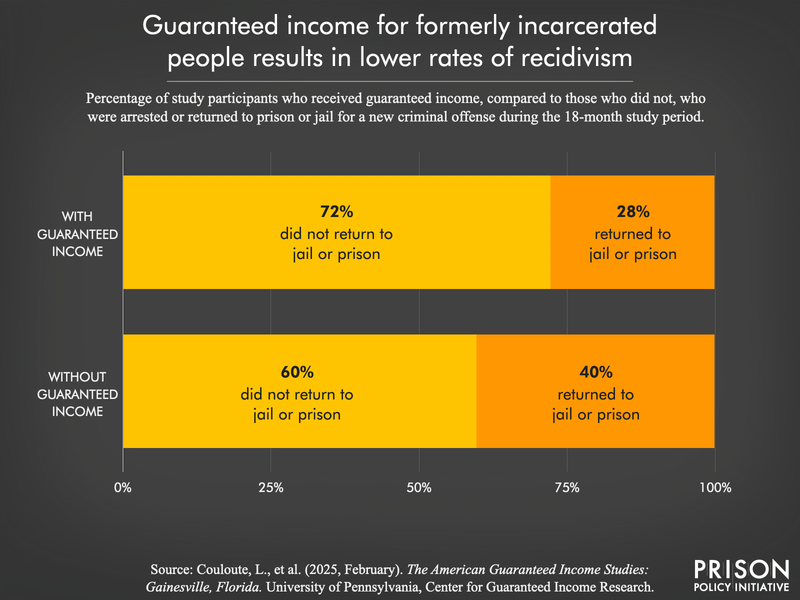
It’s not hard to see why the pilot produced these results when Florida law requires “probation fees of at least $40 per month, while eliminating exemptions from prosecution and public defense fees for indigent defendants,” according to Just Income’s study report. The findings were consistent with interviews conducted with the participants, who expressed that the guaranteed income program saved them from having to turn to crimes of survival or other criminalized activities to cover basic needs.
Guaranteed Income creates taxpayer savings and increased self-sufficiency
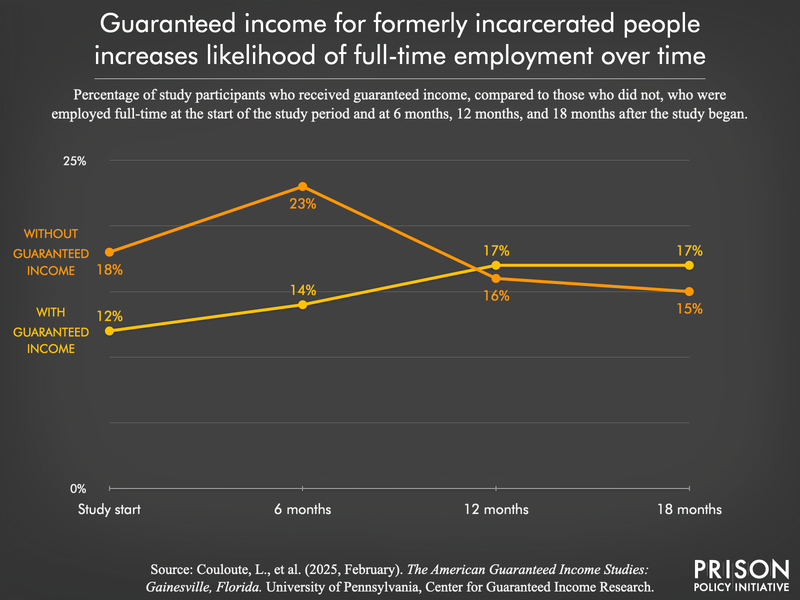
One common misconception about cash assistance in general, and guaranteed income in particular, is that it creates a disincentive to work. But guaranteed income programs actually help people find suitable and sustainable work that leads to more stable employment.
Results from the pilot showed that the guaranteed income payments actually improved participants’ self-sufficiency by strengthening their ability to obtain employment and cover their own basic living expenses.
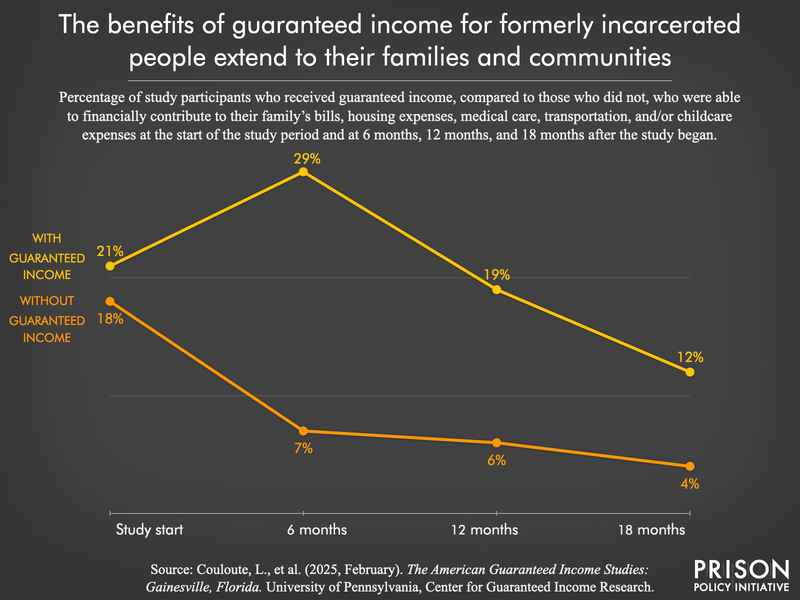
This makes sense when one considers how guaranteed income programs make people less desperate for money to cover basic needs. Not only does that remove economic incentives that can lead to recidivism, but it also allows people in reentry to find work in a hostile job market. Not being desperate to take the very first job available may make it easier for people to find well-paid, sustainable employment.
The impact of the Just Income program extended beyond the single person receiving the payment. Recipients were able to pitch in for household expenses, cover food costs, and help others in need. This means that guaranteed income not only benefits people in reentry, but their larger communities as well. Even though the cash assistance doesn’t come close to covering all expenses, letting people choose to share some of that money with family and community gives formerly incarcerated people the ability to strengthen social ties through giving back.
The study’s participants also “credited the stability provided by the Just Income program for improving their mental well-being.” Participants who received assistance experienced reduced stress, felt like they mattered more, and had higher hopes for the future. They expressed that these improvements led to “an interruption in the downward spiral of poverty, stress, substance use, and recidivism.”
These benefits not only help individuals directly impacted by incarceration and their immediate communities, but all Florida residents through significant tax savings. Florida spends over $41,000 annually to incarcerate a single person. During the study period, participants received $7,600 over 12 months. For every 100 people in the study, those payments led to 12 fewer people being reincarcerated. By conservative estimate, that averages out to a net gain for taxpayers of over $13,000 per person in the program.
Guaranteed income is a proven tool that should be used across the country
Community Spring’s Just Income program should be replicated across the country. Guaranteed income for people in reentry is a smart policy move, and Community Spring even provides consulting to those who want to start their own program for people in reentry. A key factor of their program’s success is that the payments are completely unrestricted, which enables them to maximize efficiency by allowing people to pick new uses for the funds as new challenges crop up.
There have only been a handful of other guaranteed income programs focusing on justice-involved people so far. Just Income is unique among them because it was accompanied by a rigorous academic study. Even though the other programs weren’t subject to the same level of scrutiny, they did gather some data and (of course) anecdotes, which showed the same general benefits of guaranteed income for people in reentry.
These early pilots of guaranteed income programs show promise in helping people succeed in reentry. In fact, Just Income has kept going beyond their first pilot, turning into a recurring program providing people with unconditional payments of $800 a month for one year. They are now helping other organizations to replicate this type of program.
More organizations and governments should copy these programs; guaranteed income is an efficient way to help people succeed in reentry, reducing recidivism and quickly paying for itself. Everyone deserves a fair shot at reintegrating into society, securing high-quality employment, and contributing to their communities. Just a little money every month can be the first step in achieving that goal.
-
-
AuthorPosts


- You must be logged in to reply to this topic.